
ML-For-Beginners
这是微软推出的面向机器学习初学者的免费公开课程,共12周26课配套测试,采用项目式教学,支持多语言。
这个项目值得继续研究吗?
这是微软推出的面向机器学习初学者的免费公开课程,共12周26课配套测试,采用项目式教学,支持多语言。
- 解决什么问题
- 企业培养零基础机器学习入门人才时,常面临找不到体系化、低门槛、兼顾理论与实操的公开学习资料,零散学习效果难验证、周期不可控的痛点。
- 适合什么团队
- 适合需要开展员工机器学习基础能力培训的企业团队,以及有基础编程能力、想入门经典机器学习的业务岗员工。
- 使用前注意
- 本课程仅覆盖经典机器学习内容,不涉及深度学习;完整仓库包含多语言包体积较大,可采用稀疏克隆方式下载仅核心内容。
本页用于缩短初步筛选时间,不构成技术、采购或法律结论。 正式使用前请在真实业务数据上验证,并以官方说明与许可证为准。
从官方资料看清能力、部署与采用边界
以下内容依据项目公开 README 或模型卡翻译整理,代码、命令和产品名保持原样。
项目定位
本课程是微软云倡导者团队开发的公开机器学习入门资源,主打「经典机器学习」内容,主要使用Scikit-learn工具库,不涉及深度学习相关内容,可搭配官方推出的《Data Science for Beginners》《AI for Beginners》课程体系化学习数据科学、AI相关知识。课程采用结合全球各地文化相关数据的案例设计,降低知识理解门槛。
核心课程设置
课程总周期为12周,包含26个课时,每课时均配置课前预热测验、讲义内容、知识检查节点、实操挑战、拓展阅读材料、课后测验、作业任务,涉及项目实操的课时还附带分步搭建指南和参考解决方案。 教学采用项目式设计,内容难度从低到高逐步提升,通过边做边学的方式提升知识留存率,部分课时配有短视频讲解,全部讲解视频可在微软开发者YouTube频道的「ML for Beginners」播放列表查看。课程末尾还补充有机器学习实际行业应用的拓展内容,可作为讨论或进阶作业使用。
多语言支持
课程通过自动化工具支持50余种语言版本,包括简体中文、中国香港繁体、中国澳门繁体、中国台湾繁体等中文版本,可直接在仓库的translations目录下选择对应语言查看。 如果不需要多语言内容,可采用稀疏克隆的方式下载核心课程内容,减少下载体积:
- Bash/macOS/Linux环境命令:
git clone --filter=blob:none --sparse https://github.com/microsoft/ML-For-Beginners.git
cd ML-For-Beginners
git sparse-checkout set --no-cone '/*' '!translations' '!translated_images'- Windows CMD环境命令:
git clone --filter=blob:none --sparse https://github.com/microsoft/ML-For-Beginners.git
cd ML-For-Beginners
git sparse-checkout set --no-cone "/*" "!translations" "!translated_images"
使用方式
个人/员工自学
- Fork完整仓库到个人GitHub账号,可独立学习或组队学习
- 学习流程参考:完成课前测验→阅读讲义完成对应实操,在每个知识检查节点暂停复盘→尽量自主完成项目实操,参考解决方案仅用于对照验证→完成课后测验→完成挑战任务→完成作业
- 完成一组课时学习后,可在仓库讨论区提交进度评估工具(PAT)复盘学习成果,也可查看其他学习者的复盘内容共同交流。
企业培训/教学使用
官方提供了专门的《for-teachers.md》文档,包含课程用于教学/内部培训的适配建议,可直接参考调整使用。
相关配套资源
课程配套的额外学习资源可在微软Learn对应集合获取,安装、运行课程内容遇到常见问题可参考仓库内的《TROUBLESHOOTING.md》文档排查解决。
许可证与使用建议
本项目采用MIT许可证,企业和个人均可自由使用、修改、分发课程内容,包括用于商业培训场景。 如果需要学习深度学习相关内容,本课程未覆盖,可选择官方配套的《AI for Beginners》课程学习;如果需要补充数据科学基础能力,可搭配《Data Science for Beginners》课程使用。
官方资料与来源
- data-science
- education
- machine-learning
- machine-learning-algorithms
- machinelearning
- machinelearning-python
- microsoft-for-beginners
- ml
- python
- r
- scikit-learn
- scikit-learn-python
# Getting Started

Follow these steps:
1. **Fork the Repository**: Click on the "Fork" button at the top-right corner of this page.
2. **Clone the Repository**:   `git clone https://github.com/microsoft/ML-For-Beginners.git`

> [find all additional resources for this course in our Microsoft Learn collection](https://learn.microsoft.com/en-us/collections/qrqzamz1nn2wx3?WT.mc_id=academic-77952-bethanycheum)

> 🔧 **Need help?** Check our [Troubleshooting Guide](TROUBLESHOOTING.md) for solutions to common issues with installation, setup, and running lessons.


**[Students](https://aka.ms/student-page)**, to use this curriculum, fork the entire repo to your own GitHub account and complete the exercises on your own or with a group:

- Start with a pre-lecture quiz.
- Read the lecture and complete the activities, pausing and reflecting at each knowledge check.
- Try to create the projects by c
该片段来自项目 README,仅用于初步判断;实际部署请以官方文档为准。
核对上游原始说明节选
12 weeks, 26 lessons, 52 quizzes, classic Machine Learning for all
GitHub license GitHub contributors GitHub issues GitHub pull-requests PRs Welcome
GitHub watchers GitHub forks GitHub stars
🌐 Multi-Language Support
Supported via GitHub Action (Automated & Always Up-to-Date)
Arabic | Bengali | Bulgarian | Burmese (Myanmar) | Chinese (Simplified) | Chinese (Traditional, Hong Kong) | Chinese (Traditional, Macau) | Chinese (Traditional, Taiwan) | Croatian | Czech | Danish | Dutch | Estonian | Finnish | French | German | Greek | Hebrew | Hindi | Hungarian | Indonesian | Italian | Japanese | Kannada | Khmer | Korean | Lithuanian | Malay | Malayalam | Marathi | Nepali | Nigerian Pidgin | Norwegian | Persian (Farsi) | Polish | Portuguese (Brazil) | Portuguese (Portugal) | Punjabi (Gurmukhi) | Romanian | Russian | Serbian (Cyrillic) | Slovak | Slovenian | Spanish | Swahili | Swedish | Tagalog (Filipino) | Tamil | Telugu | Thai | Turkish | Ukrainian | Urdu | Vietnamese
Prefer to Clone Locally?
This repository includes 50+ language translations which significantly increases the download size. To clone without translations, use sparse checkout:
Bash / macOS / Linux:
```bash
git clone --filter=blob:none --sparse https://github.com/microsoft/ML-For-Beginners.git
cd ML-For-Beginners
git sparse-checkout set --no-cone '/' '!translations' '!translatedimages'
```
CMD (Windows):
```cmd
git clone --filter=blob:none --sparse https://github.com/microsoft/ML-For-Beginners.git
cd ML-For-Beginners
git sparse-checkout set --no-cone "/" "!translations" "!translatedimages"
```
This gives you everything you need to complete the course with a much faster download.
Join Our Community
Microsoft Foundry Discord
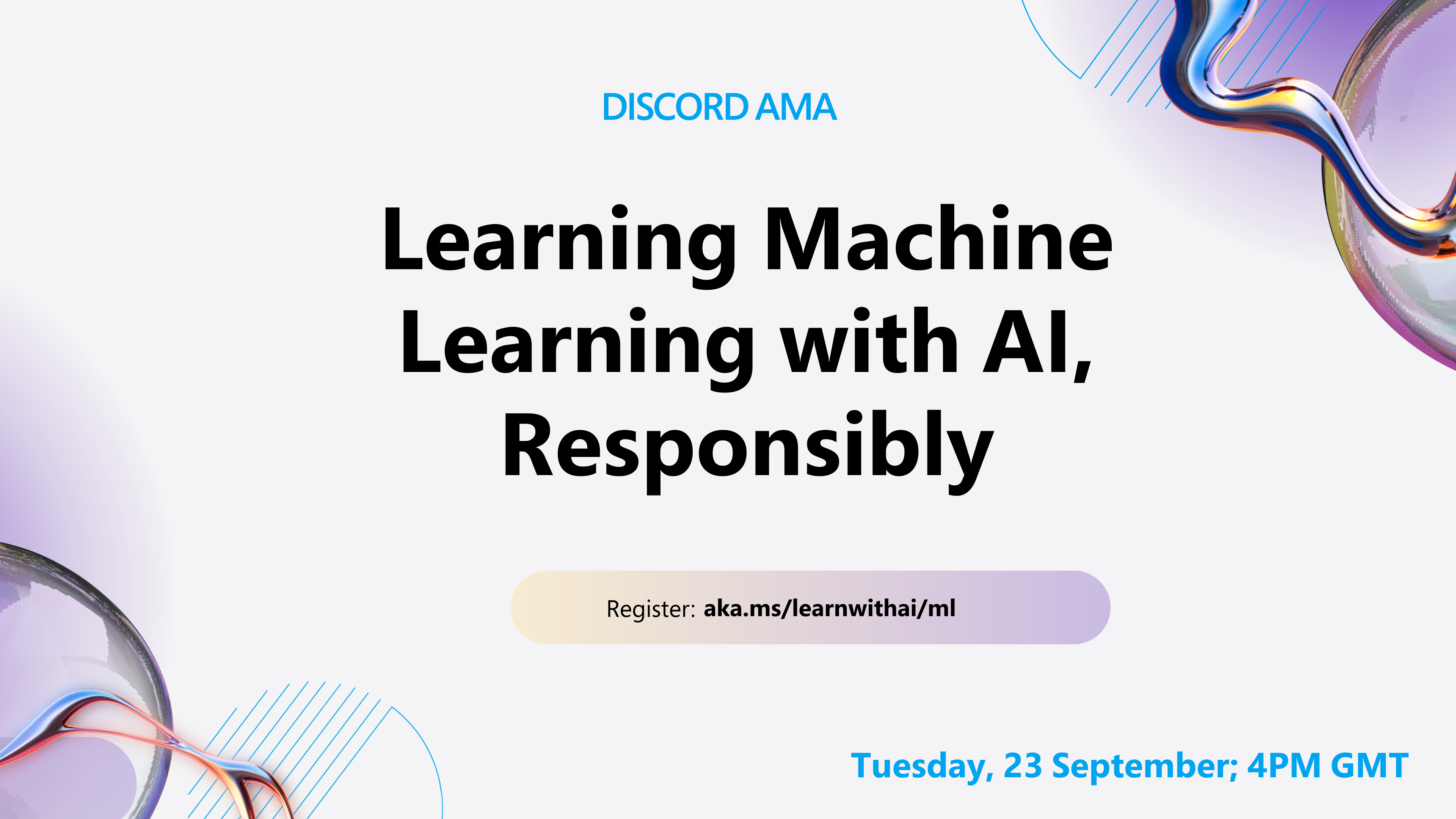
We have a Discord learn with AI series ongoing, learn more and join us at Learn with AI Series from 18 - 30 September, 2025. You will get tips and tricks of using GitHub Copilot for Data Science.
Learn with AI series
Machine Learning for Beginners - A Curriculum
🌍 Travel around the world as we explore Machine Learning by means of world cultures 🌍
Cloud Advocates at Microsoft are pleased to offer a 12-week, 26-lesson curriculum all about Machine Learning. In this curriculum, you will learn about what is sometimes called classic machine learning, using primarily Scikit-learn as a library and avoiding deep learning, which is covered in our AI for Beginners' curriculum. Pair these lessons with our 'Data Science for Beginners' curriculum, as well!
Travel with us around the world as we apply these classic techniques to data from many areas of the world. Each lesson includes pre- and post-lesson quizzes, written instructions to complete the lesson, a solution, an assignment, and more. Our project-based pedagogy allows you to learn while building, a proven way for new skills to 'stick'.
✍️ Hearty thanks to our authors Jen Looper, Stephen Howell, Francesca Lazzeri, Tomomi Imura, Cassie Breviu, Dmitry Soshnikov, Chris Noring, Anirban Mukherjee, Ornella Altunyan, Ruth Yakubu and Amy Boyd
🎨 Thanks as well to our illustrators Tomomi Imura, Dasani Madipalli, and Jen Looper
🙏 Special thanks 🙏 to our Microsoft Student Ambassador authors, reviewers, and content contributors, notably Rishit Dagli, Muhammad Sakib Khan Inan, Rohan Raj, Alexandru Petrescu, Abhishek Jaiswal, Nawrin Tabassum, Ioan Samuila, and Snigdha Agarwal
🤩 Extra gratitude to Microsoft Student Ambassadors Eric Wanjau, Jasleen Sondhi, and Vidushi Gupta for our R lessons!
Getting Started
Follow these steps:
- Fork the Repository: Click on the "Fork" button at the top-right corner of this page.
- Clone the Repository: git clone https://github.com/microsoft/ML-For-Beginners.git
find all additional resources for this course in our Microsoft Learn collection
🔧 Need help? Check our Troubleshooting Guide for solutions to common issues with installation, setup, and running lessons.
Students, to use this curriculum, fork the entire repo to your own GitHub account and complete the exercises on your own or with a group:
- Start with a pre-lecture quiz.
- Read the lecture and complete the activities, pausing and reflecting at each knowledge check.
- Try to create the projects by comprehending the lessons rather than running the solution code; however that code is available in the /solution folders in each project-oriented lesson.
- Take the post-lecture quiz.
- Complete the challenge.
- Complete the assignment.
- After completing a lesson group, visit the Discussion Board and "learn out loud" by filling out the appropriate PAT rubric. A 'PAT' is a Progress Assessment Tool that is a rubric you fill out to further your learning. You can also react to other PATs so we can learn together.
For further study, we recommend following these Microsoft Learn modules and learning paths.
Teachers, we have included some suggestions on how to use this curriculum.
Meet the Team
Promo video
Gif by Mohit Jaisal
🎥 Click the image above for a video about the project and the folks who created it!
---
Pedagogy
We have chosen two pedagogical tenets while building this curriculum: ensuring that it is hands-on project-based and that it includes frequent quizzes. In addition, this curriculum has a common theme to give it cohesion.
By ensuring that the content aligns with projects, the process is made more engaging for students and retention of concepts will be augmented. In addition, a low-stakes quiz before a class sets the intention of the student towards learning a topic, while a second quiz after class ensures further retention. This curriculum was designed to be flexible and fun and can be taken in whole or in part. The projects start small and become increasingly complex by the end of the 12-week cycle. This curriculum also includes a postscript on real-world applications of ML, which can be used as extra credit or as a basis for discussion.
Find our Code of Conduct, Contributing, Translations, and Troubleshooting guidelines. We welcome your constructive feedback!
Each lesson includes
- optional sketchnote
- optional supplemental video
- video walkthrough (some lessons only)
- pre-lecture warmup quiz
- written lesson
- for project-based lessons, step-by-step guides on how to build the project
- knowledge checks
- a challenge
- supplemental reading
- assignment
- post-lecture quiz
A note about languages: These lessons are primarily written in Python, but many are also available
上游文档较长,此处为节选。完整内容见官方项目。
 优秘智能
优秘智能