
PaddleOCR
PaddleOCR是一款可将PDF、图像文档转化为大语言模型可用结构化数据的OCR工具包,支持100余种语言,适配多种部署场景。
这个项目值得继续研究吗?
PaddleOCR是一款可将PDF、图像文档转化为大语言模型可用结构化数据的OCR工具包,支持100余种语言,适配多种部署场景。
- 解决什么问题
- 解决企业纸质扫描件、图片、非可编辑PDF等内容无法直接被AI系统调用的问题,替代人工录入整理,降低多语言、复杂版式文档的识别处理成本。
- 适合什么团队
- 需要搭建RAG(检索增强生成,可让大模型调用自有知识库内容的技术)知识库、做文档数字化、智能文档应用开发的企业团队。
- 使用前注意
- 采用Apache-2.0许可可免费商用,本地部署需根据所选功能模块查阅对应官方文档配置环境,不同硬件的适配细节可参考官方说明。
本页用于缩短初步筛选时间,不构成技术、采购或法律结论。 正式使用前请在真实业务数据上验证,并以官方说明与许可证为准。
从官方资料看清能力、部署与采用边界
以下内容依据项目公开 README 或模型卡翻译整理,代码、命令和产品名保持原样。
项目定位
PaddleOCR是一款开源OCR与文档智能处理工具,核心能力是将图像、非可编辑PDF等视觉类文档内容,转化为Markdown、JSON等结构化数据,可直接供给大语言模型调用,是企业搭建RAG、智能Agent等AI应用的基础工具。
核心能力
支持将包含表格、公式、古籍、生僻字、印章、图表的复杂文档转化为结构化格式,其中PaddleOCR-VL系列可输出Markdown、JSON格式结果,PP-StructureV3可额外提供表格单元格、文本的坐标信息,满足需要精准定位内容的场景需求。
- 智能文档解析
支持100余种语言的文字识别,其中PP-OCRv6用单一模型即可支持中文、英文、日文及46种拉丁系语言共50种语言,无需切换模型即可处理多语言混合文档。可识别身份证、路牌、书籍、工业部件等多种自然场景下的文字内容,相比上一代版本,检测准确率提升4.6%,识别准确率提升5.1%,端到端CPU推理速度提升5.2倍。
- 多场景文本识别
已与Dify、RAGFlow、Cherry Studio等主流AI开发工具深度集成,支持多种部署硬件,可满足不同场景的集成需求。
- 生态适配
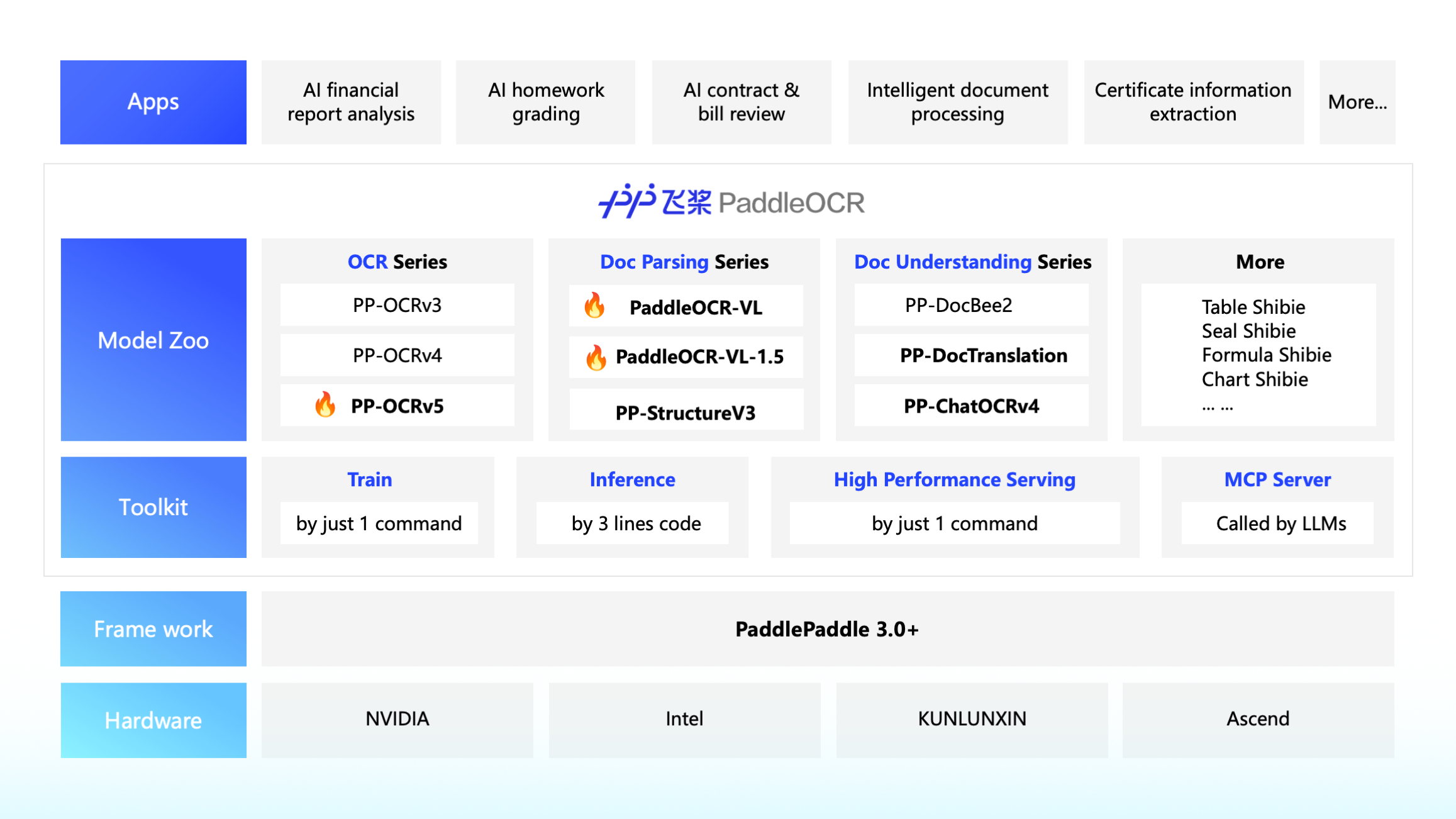
PaddleOCR Architecture
典型使用方式
用户可先访问官方网站的体验中心,无需部署即可在线测试功能效果,验证符合业务需求后再选择对应模块部署:
- 如需将文档转化为大模型可用的结构化数据,可选用PaddleOCR-VL系列
- 如需获取内容坐标做进一步处理,可选用PP-StructureV3
- 如需多场景、多语言的文字识别,可选用PP-OCR系列
- 如需高吞吐量的批量文档解析,可选用最新的HPD-Parsing模块
部署要求
工具支持Linux、Windows、Mac操作系统,适配Python3.83.12版本,硬件兼容CPU、NVIDIA GPU、昆仑芯XPU、昇腾NPU等多种设备。不同模块的部署流程可参考官方对应文档,也可部署为兼容OpenAI接口的服务,方便现有业务系统对接。
近期更新
- 2026年7月推出HPD-Parsing高吞吐量解析模型,峰值处理速度可达4752token/s,兼顾解析准确率与处理效率,适合批量文档处理场景
- 2026年6月发布3.7.0版本,升级PP-OCRv6,提供1.5M、7.7M、34.5M三种参数规格的模型,分别适配边缘端、移动端、服务端部署需求
- 2026年5月发布的PaddleOCR-VL-1.6版本,在OmniDocBench v1.6测试集上准确率达96.3%,在古籍、生僻字、印章、图表识别上效果有明显提升
- 2026年4月发布的3.5.0版本新增Office文档转Markdown、解析结果导出DOCX功能,同时推出浏览器端运行的PaddleOCR.js SDK
许可与采用建议
项目采用Apache-2.0开源许可,企业可免费商用,无需开源二次开发的代码。如果你的团队有文档数字化、企业知识库搭建、智能文档类应用开发的需求,可先通过官方在线体验验证效果,再根据业务量级选择对应规格的模型部署。
官方资料与来源
- ai4science
- chineseocr
- document-parsing
- document-translation
- kie
- ocr
- paddleocr-vl
- pdf-extractor-rag
- pdf-parser
- pdf2markdown
- pp-ocr
- pp-structure
## 🚀 Quick Start

### Step 1: Try Online
PaddleOCR official website provides interactive **Experience Center** and **APIs**—no setup required, just one click to experience.

👉 [Visit Official Website](https://www.paddleocr.com)

### Step 2: Local Deployment
For local usage, please refer to the following documentation based on your needs:

- **PP-OCR Series**: See [PP-OCR Documentation](https://www.paddleocr.ai/latest/en/version3.x/pipeline_usage/OCR.html)
- **PaddleOCR-VL Series**: See [PaddleOCR-VL Documentation](https://www.paddleocr.ai/latest/en/version3.x/pipeline_usage/PaddleOCR-VL.html)
- **PP-StructureV3**: See [PP-StructureV3 Documentation](https://www.paddleocr.ai/latest/en/version3.x/pipeline_usage/PP-StructureV3.html)
- **More Capabilities**: See [More Capabilities Documentation](https://www.paddleocr.ai/latest/en/version3.x/pipeline_usage/pipeline_overview.html)
该片段来自项目 README,仅用于初步判断;实际部署请以官方文档为准。
核对上游原始说明节选
Turn any PDF or image document into structured data for your AI. A powerful, lightweight OCR toolkit that bridges the gap between images/PDFs and LLMs. Supports 100+ languages.
Global Leading OCR Toolkit & Document AI Engine
English | 简体中文 | 繁體中文 | 日本語 | 한국어 | Français | Русский | Español | العربية
PyPI Downloads Used by python os hardware
AI Studio Ask DeepWiki License
PaddleOCR converts PDF documents and images into structured, LLM-ready data (JSON/Markdown) with industry-leading accuracy. With 70k+ Stars and trusted by top-tier projects like Dify, RAGFlow, and Cherry Studio, PaddleOCR is the bedrock for building intelligent RAG and Agentic applications.
🚀 Key Features
📄 Intelligent Document Parsing (LLM-Ready)
Transforming messy visuals into structured data for the LLM era.
- SOTA Document VLM: Featuring PaddleOCR-VL-1.6 (0.9B), the industry's leading lightweight vision-language model for document parsing. It achieves 96.3% accuracy on OmniDocBench v1.6, leads in text, formula, and table recognition, and shows significantly enhanced capabilities in ancient documents, rare characters, seals, and charts, with structured outputs in Markdown and JSON formats.
- Structure-Aware Conversion: Powered by PP-StructureV3, seamlessly convert complex PDFs and images into Markdown or JSON. Unlike the PaddleOCR-VL series models, it provides more fine-grained coordinate information, including table cell coordinates, text coordinates, and more.
- Production-Ready Efficiency: Achieve commercial-grade accuracy with an ultra-small footprint. Outperforms numerous closed-source solutions in public benchmarks while remaining resource-efficient for edge/cloud deployment.
🔍 Universal Text Recognition (Scene OCR)
The global gold standard for high-speed, multilingual text spotting.
- 100+ Languages Supported: Native recognition for a vast global library. PP-OCRv6 supports 50 languages with a single unified model (Chinese, English, Japanese, and 46 Latin-script languages) — no model switching needed for multilingual documents.
- Complex Element Mastery: Beyond standard text recognition, we support natural scene text spotting across a wide range of environments, including IDs, street views, books, and industrial components
- Performance Leap: PP-OCRv6 achieves +4.6% detection and +5.1% recognition accuracy over PP-OCRv5, surpassing mainstream Vision-Language Models. 5.2× CPU inference speedup end-to-end.
🛠️ Developer-Centric Ecosystem
- Seamless Integration: The premier choice for the AI Agent ecosystem—deeply integrated with Dify, RAGFlow, Pathway, and Cherry Studio.
- LLM Data Flywheel: A complete pipeline to build high-quality datasets, providing a sustainable "Data Engine" for fine-tuning Large Language Models.
- One-Click Deployment: Supports various hardware backends (NVIDIA GPU, Intel CPU, Kunlunxin XPU, and diverse AI Accelerators).
📣 Recent updates
🔥 2026.07.22: HPD-Parsing is now available
- HPD-Parsing is a lightweight vision-language model designed for high-throughput document parsing. It adopts a hierarchical parallel decoding paradigm and Progressive Multi-Token Prediction (P-MTP), achieving a peak throughput of 4,752 tokens/s on public benchmarks while maintaining competitive parsing accuracy.
- HPD-Parsing supports both OpenAI-compatible serving and local inference through a customized vLLM runtime, making it suitable for document parsing scenarios with high demands on inference efficiency and deployment throughput.
- See the HPD-Parsing usage tutorial for environment setup, serving, and local inference instructions.
2026.06.11: Release of PaddleOCR 3.7.0
- PP-OCRv6 highlights:
- Accuracy boost: Medium tier achieves +4.6% detection and +5.1% recognition over PP-OCRv5server, surpassing mainstream VLMs (Qwen3-VL-235B, GPT-5.5) with only 34.5M parameters.
- 50 languages unified: Single model covers Chinese, English, Japanese, and 46 Latin-script languages — no model switching needed.
- Specialized scenarios: Major improvements in digital displays, dot-matrix characters, tire prints, and industrial text recognition.
- Faster inference: 5.2× CPU speedup (OpenVINO), 6.1× on Apple M4 (tiny), 0.13s on A100 GPU.
- Three tiers for all scenarios: tiny (1.5M) / small (7.7M) / medium (34.5M) for edge, mobile, and server deployment.
- Model availability: All models are available on HuggingFace and ModelScope.
2026.05.28: Release of PaddleOCR 3.6.0
- PaddleOCR-VL-1.6 highlights:
- New SOTA Accuracy: Achieves over 96.3% on OmniDocBench v1.6, also sets new SOTA on OmniDocBench v1.5 and Real5-OmniDocBench, leading both open-source and proprietary solutions in text, formula, and table recognition.
- Comprehensive Capability Upgrade: Significant improvements in table, ancient document, and rare character recognition, with notably enhanced seal recognition, spotting, and chart understanding across multiple scenarios.
- Seamless Migration: Model architecture is fully consistent with PaddleOCR-VL-1.5, enabling zero-cost adaptation—swap and go.
- Try it now: Available on HuggingFace or our Official Website.
2026.04.21: Release of PaddleOCR 3.5.0
- Flexible inference backends: Seamlessly switch between Paddle static graph, Paddle dynamic graph, or Transformers. PaddleOCR is now deeply integrated with the Hugging Face ecosystem, and 20 major models support Transformers as the inference backend.
- Office documents to Markdown: Convert common document formats such as Word, Excel, and PowerPoint into Markdown.
- DOCX export for parsed results: The PaddleOCR-VL series, PP-StructureV3, and PP-DocTranslation now support exporting parsed results to DOCX for convenient viewing and editing in Microsoft Word.
- Official browser inference SDK: Released PaddleOCR.js, the official browser inference SDK that supports running PP-OCRv5 directly in the browser.
2026.01.29: Release of PaddleOCR 3.4.0
- PaddleOCR-VL-1.5 (SOTA 0.9B VLM): Our latest flagship model for document parsing is now live!
- 94.5% Accuracy on OmniDocBench: Surpassing top-tier general large models and specialized document parsers.
- Real-World Robustness: First to introduce the PP-DocLayoutV3 algor
上游文档较长,此处为节选。完整内容见官方项目。
 优秘智能
优秘智能